русский
 Español
 عربى
Manufacturing Intelligence — Deep Dive
An automatic assembly machine is a self-operating production system that joins, fastens, positions, or combines multiple components into a finished product with minimal or no human intervention during the assembly cycle. Unlike a manual assembly line — where operators physically pick up, orient, and join parts by hand — an automatic assembly machine relies on actuators, sensors, feeders, and control systems to perform these tasks at speeds and consistency levels manual labor cannot match.
The core difference lies in three areas: speed, consistency, and labor dependency. An automatic assembly machine can typically produce output 3 to 8 times faster than a comparable manual station, while reducing part-to-part variation because motion paths, force application, and timing are programmed rather than performed by hand. A manual assembly line, by contrast, offers greater flexibility for last-minute changes and lower upfront investment, but is more susceptible to fatigue-related errors and throughput fluctuations across shifts.
If your priority is high-volume, repeatable output with tight tolerances, an automatic assembly machine is almost always the better long-term choice.
How Automatic Assembly Machines Actually Work
Most automatic assembly machines operate on a closed-loop cycle: parts are fed via vibratory bowls, trays, or robotic pick-and-place arms, positioned using fixtures or vision-guided alignment, and then joined through pressing, screwing, welding, gluing, or snap-fitting mechanisms. A programmable logic controller coordinates the timing between each subsystem, ensuring every cycle repeats with near-identical precision.
Core Components
- Feeding systems — vibratory bowls, conveyor tracks, robotic feeders
- Positioning and fixturing units for accurate part placement
- Joining mechanisms such as press-fit heads, ultrasonic welders, or screwdriving spindles
- Vision inspection systems for real-time quality checks
- A control system governing the entire sequence
Many modern assembly line machines integrate multiple stations into a single continuous system, where each station performs one specific task before passing the semi-finished product to the next. This modularity allows manufacturers to scale production without redesigning the entire line from scratch.
Automatic vs. Manual: A Direct Comparison
The table below summarizes the practical differences manufacturers weigh most heavily when choosing between the two approaches.
| Factor | Automatic Assembly Machine | Manual Assembly Line |
|---|---|---|
| Cycle Time | 1–5 seconds per unit | 15–60 seconds per unit |
| Error Rate | Below 0.5% with vision inspection | 2%–8% depending on fatigue |
| Upfront Investment | High — equipment, tooling, integration | Low — workstations, hand tools |
| Labor Requirement | One operator per multiple machines | One operator per station |
| Changeover Flexibility | Moderate — reprogramming or tooling change | High — immediate operator adjustment |
| Best Suited Volume | Medium to high, repetitive tasks | Low volume, high product variation |
These figures vary by industry, but the pattern holds consistently across electronics, automotive components, medical devices, and consumer goods manufacturing: automation wins on throughput and consistency, while manual labor wins on adaptability.
Where CNC Assembly Machines Fit Into the Picture
A cnc assembly machine represents a specific category of automatic assembly equipment that uses computer numerical control to guide precision movements during the assembly process. Rather than relying purely on fixed mechanical cams or pneumatic sequencing, a CNC-based system uses programmable motion control to achieve micron-level positioning accuracy — especially valuable when assembling small, delicate, or high-tolerance components such as connectors, sensors, or precision fasteners.
automatic assembly machines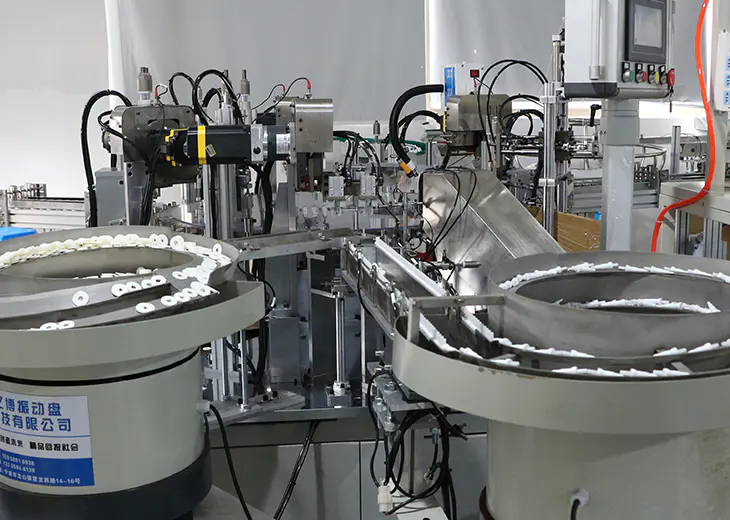
Compared to a conventional automatic assembly machine built on fixed tooling, a cnc assembly machine offers greater programmability. Operators can adjust motion paths, force thresholds, and positioning coordinates through software rather than physically retooling the machine.
When a CNC-Based System Makes Sense
- When tolerance requirements fall below 0.05mm
- When multiple product variants share a common assembly platform
- When frequent software-driven adjustments are more practical than hardware changes
- When traceability and process data logging are required for quality audits
CNC-based assembly systems are best evaluated by tolerance requirements first, then by how frequently product variants rotate through the same line.
Cost and Return on Investment
A typical automatic assembly machine handling a mid-complexity product might cost between $50,000 and $250,000, depending on the number of stations and level of customization. If that machine replaces three manual assembly operators working across two shifts, and average fully loaded labor cost is $40,000 per operator annually, the labor savings alone can reach $120,000 per year. In this scenario, the machine often pays for itself within 18 to 30 months.
Manual assembly lines, by comparison, have a lower barrier to entry but scale poorly. Adding capacity usually means hiring and training additional operators, which increases both direct labor costs and indirect costs such as onboarding, turnover, and quality variability.
Underestimating changeover and validation time is the most common reason automation ROI projections fall short in practice.
Quality Consistency: Why Automation Reduces Defects
Human assembly work is inherently variable. Even highly trained operators experience micro-fluctuations in grip strength, timing, and alignment across a shift, especially during the final hours when fatigue sets in. Studies of manual assembly operations commonly report defect rates climbing by 15% to 30% during the last two hours of a shift compared to the first two hours.
An automatic assembly machine does not experience fatigue. Its force application, alignment, and timing remain constant from the first unit to the ten-thousandth unit, provided the machine is properly maintained and calibrated.
Common Quality Control Features
- In-line vision inspection to detect misaligned or missing parts
- Force and torque monitoring during fastening operations
- Automatic rejection of out-of-tolerance assemblies
- Data logging for traceability and root-cause analysis
Manufacturers who add in-line vision inspection typically see defect escape rates drop below 0.5% within the first production quarter.
Flexibility and Changeover: The Manual Line's Advantage
Despite the clear speed and quality advantages of automation, manual assembly lines still hold a meaningful edge in flexibility. A trained operator can adapt to a new product variant within minutes, simply by following a new work instruction sheet. An automatic assembly machine, particularly one built on fixed tooling rather than a cnc assembly machine platform, may require hours or even days of retooling, reprogramming, and validation before it can run a different product configuration.
This is why many manufacturers adopt a hybrid strategy: high-volume, stable products run on automatic assembly machines or full assembly line machines, while low-volume or highly customized products remain on manual stations.
Safety Considerations Between the Two Approaches
Automatic assembly machines introduce different safety considerations than manual assembly lines. Manual lines primarily deal with ergonomic risks — repetitive strain injuries, awkward postures, and cumulative fatigue. Automatic assembly machines shift the risk profile toward mechanical hazards such as pinch points, moving actuators, and high-speed motion, which require guarding, light curtains, and emergency stop systems.
Bypassing interlocked safety enclosures during maintenance is one of the leading causes of injury on automated assembly lines.
Choosing the Right Approach for Your Production Needs
Deciding between an automatic assembly machine, a cnc assembly machine, or a manual line ultimately comes down to three questions: What is your expected production volume? How tight are your tolerance requirements? How often do your product designs change?
Quick Decision Guide
- High volume, stable design → automatic assembly machine or assembly line machines
- High precision, multiple variants → cnc assembly machine
- Low volume, frequent design changes → manual assembly line
- Mixed production needs → hybrid line combining both approaches
Final Takeaway
An automatic assembly machine delivers faster cycle times, lower defect rates, and better long-term cost efficiency than a manual assembly line, but requires a higher upfront investment and offers less immediate flexibility. A cnc assembly machine extends these benefits further by adding programmable precision, making it especially valuable for manufacturers handling tight tolerances or multiple product variants. The right choice depends on your specific production volume, tolerance requirements, and how frequently your designs change — and in many cases, a combination of automatic assembly machines, assembly line machines, and manual stations delivers the best overall balance of speed, quality, and adaptability.